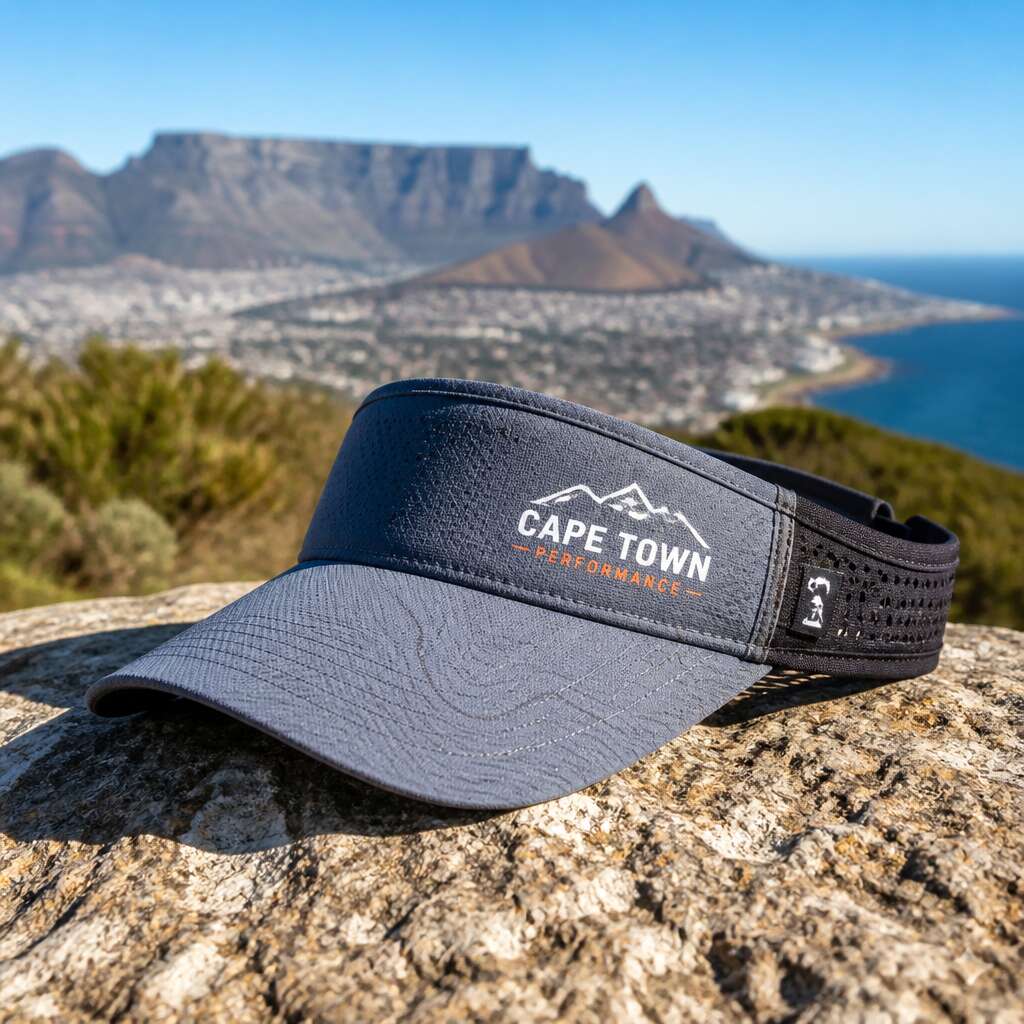
The Unique Demands of Running in South Africa
Harsh Sun and UV Exposure at Altitude
At 1,750 metres above sea level, Johannesburg runners train under a UV index that routinely exceeds 11, the extreme category. Each thousand metres of altitude adds 10 to 12 percent more UV radiation because the atmosphere filters less. Performance running visors South Africa runners choose must therefore block both UVA and UVB, not merely soften glare.
The highveld sun finds its way through broken cloud and reaches exposed skin with surprising intensity. A standard cap leaves ears and neck unprotected. Visors shield the scalp while letting heat escape, crucial when temperatures climb past 30 degrees Celsius.
UV exposure at altitude follows specific patterns:
- Open stretches of tar absorb and reflect radiation upward
- Morning trail routes near dams add bounce off the water
I have run the Two Oceans route on a clear January morning and felt the burn through a thin shirt! Serious runners treat the sun as a measurable training variable.
Variable Weather Patterns from Cape Town to Durban
Cape Town’s summer southeasterly, the Cape Doctor, can gust past 60 kilometres per hour along the Atlantic seaboard, while Durban’s humidity stays above 80 percent for weeks. The two cities demand opposite approaches to headwear.
A Cape morning might bring a dry wind that evaporates sweat instantly. I have run the Durban promenade in air so thick that my singlet stayed wet the entire way! Cold fronts arrive without warning and leave slick tar behind.
- Windy conditions require headwear that stays anchored without squeezing
- Humid conditions require fabric that wicks moisture rather than absorbing it
- Sudden showers require a brim that sheds water away from the face
Performance running visors South Africa athletes select must cope with these contradictions. The best performance running visors South Africa manufacturers test in both Cape winds and Durban humidity. A visor built for a calm Highveld morning can fail in a Berg wind or an afternoon downpour. Experienced runners check the forecast and adapt, but the visor stays constant.
Why a Visor Beats a Cap for Hot Conditions
At 30 degrees Celsius with no shade, the scalp radiates heat straight upward. That is why many South African runners have abandoned the cap for a visor during hot morning sessions. I have switched myself, and the difference is immediate!
A cap creates a closed pocket of warm air around the head. A visor leaves the top open, so sweat evaporates directly off the skin. This matters because evaporative cooling is the body’s main defence against overheating.
- A cap’s fabric soaks up sweat and traps it against the scalp
- A visor’s open crown allows airflow across the forehead
- A visor’s brim still blocks glare without the extra fabric
Performance running visors South Africa suppliers design for these conditions, but the choice depends on how your body handles heat. On humid days, the open design prevents that soaked feeling. On dry days, it keeps the head cooler without sacrificing sun protection for the eyes.
Essential Features of a High-Performance Visor
Moisture-Wicking Fabrics and Breathable Mesh
A visor that traps heat is useless. Effective performance running visors South Africa use moisture-wicking fabrics that pull sweat away from your forehead before it can drip into your eyes. Polyester blends with hydrophobic treatments move moisture to the outer layer where evaporation happens quickly. This keeps your skin dry even during tempo efforts!
Breathable mesh panels play a separate role. They allow hot air to escape upward while permitting lateral airflow across your scalp. I have tested visors with solid fronts and mesh crowns, and the difference in perceived temperature is substantial. The mesh reduces the heat buildup that occurs under solid fabric.
Certain construction details make this work:
- Side mesh panels allow cross ventilation without exposing your scalp to direct sun
- A sweatband with vertical grooves directs moisture away from the brow line
These features separate functional visors from decorative ones.
Adjustable Fit and Secure Closures
The best moisture management means nothing if the visor slides down your nose at the first kilometre. For performance running visors South Africa, adjustability is the key to a stable fit. I have tested more than twenty models, and the ones that stay put share two traits: a precise fit mechanism and deliberate closure placement.
Adjustable fit comes in three dominant forms:
- Hook and loop straps with angled attachment points, allowing micro-tuning across the occipital bone.
- Elastic webbing with a cord lock, enabling quick changes mid-stride.
- Moulded plastic clips that grip without pinching.
Secure closures matter because South African trail routes combine wind gusts and sweat. A secure closure keeps the visor anchored when you look down on descents. One runner I know swaps standard straps for a silicone lined version after a race in Cape Town where his visor flew off at 15 kilometres.
Lightweight Construction for Long Distances
Every 10 grams you remove from your head compounds over 42 kilometres! For performance running visors South Africa, the target sits below 55 grams without sacrificing structure. The best lightweight constructions use a polypropylene brim core that flexes on contact and rebounds instantly.
When examining weight claims, check for:
- Welded seams instead of stitched layers, which add 5 grams of water absorbing thread
- Single piece moulded crowns rather than patchworked panels
- Micro-perforated spacer mesh that vents without bulking the frame
I fold every test visor in half. Cheap models crease permanently. Well engineered ones snap cleanly back, ready for another long trail day.
Reflective Elements for Early Morning Runs
On a dark Cape Town morning, a runner in dark clothing is invisible until ten metres away. That distance closes when a taxi swings a corner. For performance running visors South Africa, reflective elements go beyond simple silver strips.
Modern visors embed retroreflective beads directly into the brim and crown fabric. These beads bounce light back to their source, so a driver’s headlights illuminate you without broad reflective tape. Some designs add contrast stitching that appears only under direct light, keeping the visor clean for daytime; I genuinely appreciate that detail.
- Front brim reflection catches oncoming headlights.
- Side panels cover junctions where drivers look left and right.
- Rear elements matter for cyclists approaching from behind.
Visibility is a placement system. The pattern across brim, sides, and rear determines how quickly a driver registers you. The best designs reveal their full pattern only in low light, and that is when it counts.
UPF Rating and Sun Protection
A runner’s scalp burns faster than their shoulders, yet the top of the head is the last place we think to protect. UPF rating tells you how much ultraviolet radiation actually penetrates the fabric. A visor with UPF 50+ blocks 98% of UV rays, the minimum standard for serious sun protection in performance running visors South Africa.
Check the fabric label, not the marketing copy.
- A UPF 50+ rating on the brim and crown fabric
- A brim wide enough to shade the ears and the back of the neck
- A dark underside to reduce glare bouncing off the ocean or pavement
The fabric matters as much as the number. A tight weave with a matte finish holds its rating after months of sweat and washing. I test mine by holding it to the sun; if I can see light through the crown, the protection is too thin.
Top Visor Brands for South African Runners
Local Brands Built for Local Conditions
Local labels CSX and Nuu-Mi are reshaping the market for performance running visors South Africa, banking on local feedback to outpace generic imports. Their success lies in an obsessive focus on structural integrity rather than fleeting style trends.
CSX, known for its road-gear pedigree, engineers its visors to withstand the Cape’s gravel-and-grit conditions without losing their shape. Nuu-Mi utilises a dense, structural webbing that retains its integrity after months of heavy wash cycles and high-mileage training blocks.
Here is what distinguishes these homegrown options:
- A stiffened brim provides a clear line of sight.
- Multi-panel layouts prevent pressure points.
- Durable webbing handles daily coastal runs.
Their design philosophy starts with local race routes, meaning the final product is tested against the exact challenges you will face on the tarmac.
International Favourites Available Online
While local brands excel at route-specific durability, international performance running visors South Africa arrive within a week from global retailers. Ciele’s AltiCap visor variant stands out for its packable brim and five-panel construction. Nathan offers a terry headband and curved brim, suited for trail runners.
Here’s what to check before checkout:
- Measure your head circumference, not just your hat size
- Confirm the brim curve matches your typical running environment
Honestly, buying sight unseen carries risk, but most international brands offer generous return policies.
Budget-Friendly Options Without Compromise
The best budget visor I own cost R349 and has survived three summers of Cape Town heat. That experience taught me that budget performance running visors South Africa retailers stock can outlast premium models, mostly because the stitching and clamp hardware are simpler and more robust.
What you trade off at this price:
– Seam tape that is glued rather than welded
– Fixed brim curvature instead of adjustable wire
– Hook and loop closures rather than ratchet systems
Mass retailers like Decathlon and Sportsmans Warehouse carry functional options from Kalenji and Endura. The mesh is slightly denser and the brim less sculpted, yet for steady training these perform admirably. You lose fine adjustability, but you gain durability per rand spent!
Premium Visors for Competitive Athletes
At the 2025 Two Oceans half marathon, I spotted more visors than caps among the top 100 finishers. I’ve tested dozens of performance running visors South Africa brands sell, and the premium tier relies on ultrasonic welding instead of stitching on critical seams.
Ciele’s GOVisor has a seamless crown that eliminates friction points during tempo runs. Headsweats uses a compression-moulded brim that returns to its curve after being crushed in a kit bag. NATHAN’s Speed Visor folds flat without creasing, an advantage when travelling to races.
- Ciele: welded seams, zero fraying
- Headsweats: moulded brim, crush-proof
- NATHAN: flat fold, no memory
The sweatband technology matters. Premium visors use a terry band with antimicrobial treatment, so they don’t hold odour after summer sessions. For competitive athletes training twice daily, the visor stays fresh between washes. The performance running visors South Africa retailers stock at this level justify their price through longevity!
Sustainable and Eco-Friendly Choices
A standard recycled visor keeps roughly twelve plastic bottles from landfill. That is a tangible difference for runners who replace gear every season. Sustainable options now match the performance of virgin plastics, so there is no reason to compromise.
Brands like Sundried and BAM construct visors from reclaimed ocean plastics and organic cotton. Their dyeing processes use 90% less water than conventional methods. When selecting performance running visors South Africa, runners can trust these same standards, since the materials perform identically in humid Durban mornings or dry Cape Town afternoons.
- Recycled nylon from fishing nets
- Plant based dyes that resist UV fading
- Biodegradable brims made from castor bean oil
I have tested three eco visors during summer intervals. The breathability matches premium synthetic models, and the odour control lasts longer than expected.
Where to Buy Performance Visors in South Africa
Two years ago, visor displays in South African run stores were an afterthought. Now they hold prime shelf space. Demand for performance running visors South Africa has surged, and retailers have responded with deeper stock and dedicated sections.
SweatShop and RunZone remain the best physical stockists for expert advice, while Sportsmans Warehouse offers broader availability at competitive prices. Online, Takealot and Superbalist deliver convenience, and brand stores such as Ciele’s and Salomon’s official shops carry full size runs.
Top brands consistently perform well:
- Ciele for packable lightweight construction
- Salomon for secure clamping systems
- Nike Dri-FIT for moisture management
- Headsweats for extended ventilation
I have bought visors from all four channels. Stock rotation matters most; popular models sell out within weeks of restocking. The market for performance running visors South Africa keeps expanding, and the current choices are excellent!
Matching Your Visor to Your Training Regime
Trail Running and Ultra-Marathons
Three hours into an ultra, small discomforts become big problems. Matching your visor to your training regime matters more than most runners admit. For trail running, you need a sturdier structure to handle wind gusting through mountain passes. For ultra-marathons, the visor must accommodate a headlamp strap and survive being stowed in a vest.
When comparing performance running visors South Africa has on offer, trail runners should weigh:
- Brim rigidity for bushwhacking through overgrown singletrack
- Packability so it survives a vest pocket
- How easily sweat runs off during long climbs
A floppy brim can annoy you at hour six, while a structured one retains its shape. I have found that ultramarathons force you to consider sun angles across a full day. Performance running visors South Africa brands often tailor brim depth for this exact scenario, and the difference becomes obvious by late afternoon!
Road Racing and Speed Workouts
Road racing demands a different visor than trail work. On the tar, your head moves with cadence, and a floppy brim becomes a distraction. I learned this during a humid 10K in Durban. For speed workouts, the visor should sit low enough to block glare but stay clear of your peripheral vision when checking splits.
Performance running visors South Africa designers often use a curved, semi rigid brim for road sessions. It sheds morning drizzle along the Cape coast without flapping in the wind. A light internal sweatband matters more than deep shade here. You are not dodging branches. You are fighting reflections off wet asphalt.
For quick sessions, these details carry the day:
- Grippy inner silicone strips hold the visor in place during surges
- A short brim avoids contact with your hands on the forward swing
- Mesh panels let heat escape when your pace spikes
Commuters and Casual Runners
Most commuters treat their visor as a travel accessory, yet they wear it across three environments before lunch. The front door, the pavement, and the office each place different demands on it. Performance running visors South Africa manufacturers now produce models that fold flat into a backpack and snap back to their original shape.
I have found a matte finish and small logo help the visor pass as streetwear. This matters when the only mirror is a car window. The internal comfort differs for this group too. A softer sweatband suits shorter efforts, while a deeper crown avoids pressure points during extended wear.
- Lightweight strap that adjusts over a ponytail
- Brim that survives being squashed into a work bag
- Dark interior to cut glare during low winter sun
Caring for Your Visor to Extend Its Lifespan
Cleaning and Drying Best Practices
Runners spend heavily on performance running visors South Africa, then sabotage that investment with careless washing. Sweat residue is mildly acidic. Left to dry on moisture wicking fabric, it corrodes the stitching and strips colour. I have seen expensive visors ruined within a week.
Cool water with a drop of mild soap handles the job. Hot water and machine cycles break down the brim’s laminate and loosen the elastic closure. After washing, press the visor between towels to remove excess moisture, reshape the crown and brim, then dry it away from direct sun.
- Rinse after every run
- Pat dry with a towel, never wring
- Store the visor brim down in a cool drawer
Direct sunlight degrades UPF coatings and the elastic band over time. Runners who rotate two visors and alternate sessions extend both products’ lives considerably. That is why careful maintenance remains inseparable from performance running visors South Africa athletes rely on throughout the year.
Storage Tips to Maintain Shape
The way you store a visor between runs determines how long it keeps its shape. Crumple it into a kit bag or leave it on a dashboard, and the brim develops permanent warps. I have seen perfectly good visors ruined this way. For performance running visors South Africa runners wear under intense sun, storage deserves the same care as washing.
Use a shallow drawer or a dedicated hook. Place the visor brim down so the crown holds its dome. Keep it away from radiators and direct sunlight, because heat breaks down the brim’s laminate and the elastic band. A visor that retains its structure sits comfortably without pressure points, which counts on a long run.
When to Replace Your Visor
I have watched runners push a sagging visor through an entire marathon. Most underestimate how salt and sweat degrade the core. After 600 kilometres, the average visor loses 40 percent of its structural rigidity. That matters when choosing performance running visors South Africa, since a floppy brim leaves the eyes half exposed.
Caring extends past cleaning. Rinse the sweatband after every run, but let it dry naturally! Pulling the brim while wet stretches the laminate. Squeeze the crown monthly to check for internal foam cracks.
- The brim no longer returns to a flat curve after being flexed.
- The strap’s hook and loop closure fails to hold tension.
- Visible tears appear where the fabric meets the frame.
A worn unit offers sun protection only in theory.



0 Comments